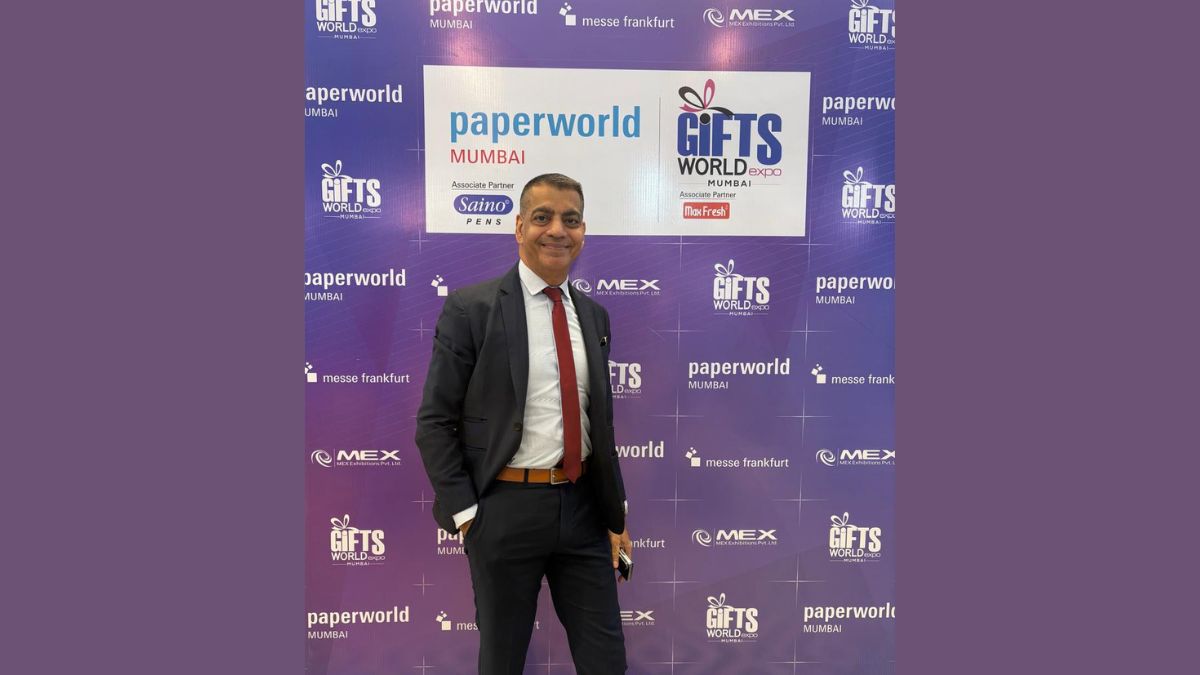
In an interview with Labels Flexibles & More, Raj Manek shares insights on India’s economic trajectory, startup ecosystem, and why global businesses are increasingly looking at India as a reliable manufacturing and sourcing hub.
India is currently in a “sweet spot” in terms of economic growth and business sentiment, according to Raj Manek, Executive Director & Board Member, Messe Frankfurt Asia Holdings Ltd.. Speaking on the sidelines of the Gift World Expo with Labels Flexible and More, Manek said the Indian market is performing significantly better than many global economies.
“Across most sectors, the sentiment in India is extremely buoyant. I travel frequently between Europe and India, and the contrast in business sentiment is clear. Compared with Europe—and even many other global markets—India is miles ahead,” he said.
According to Manek, India has been on a steady upward trajectory for the past five to seven years and is poised for even stronger growth over the next decade. “India is already among the world’s largest economies and is expected to become the third largest by 2030. The next decade, if leveraged correctly, truly belongs to India,” he noted.
A major factor driving this growth is the country’s expanding manufacturing ecosystem. Initiatives such as self-reliance and increased domestic manufacturing have strengthened India’s position as a reliable global production hub. Significant investments in infrastructure—including highways, railways, and ports—have also helped address supply chain bottlenecks that once limited manufacturing growth.
“Manufacturing alone is not enough; the ability to move goods efficiently from A to B is critical. India has made tremendous progress in infrastructure over the last five years, and that is enabling companies to compete globally,” Manek explained.
He also highlighted the growing global shift toward diversified sourcing. Following the disruptions caused by the pandemic, companies worldwide are actively seeking alternatives to single-country sourcing models. “Many businesses are looking for a reliable alternative. India may not always be the cheapest option, but it offers reliability, quality, and timely delivery—qualities that global buyers increasingly value,” he said.
India’s demographic advantage and expanding consumer market are also fuelling growth in entrepreneurship. According to Manek, the number of startups participating in industry exhibitions has increased significantly in recent years. “The rise in startups is largely driven by the strong domestic demand. Entrepreneurs see a large market here first, and once they establish themselves, they expand globally,” he said.
Manek also pointed to the changing lifestyle and consumption patterns in India, which are creating new opportunities across sectors. From home décor to branding and digital advertising infrastructure, the country’s rapidly evolving urban landscape is driving demand for new products and services.
Discussing the exhibition industry, Manek said the inaugural edition of the Gift World Expo in Mumbai has started on a strong note, with more than 425 exhibitors and over 10,000 brands showcased on the exhibition floor. The event is co-located with Paperworld India, reflecting the growing convergence between gifting, stationery, and related industries.
“Gifting is deeply embedded in Indian culture. Whether it is festivals, weddings, corporate occasions, or social visits, gifting plays an important role. The segment has expanded far beyond traditional products and now includes everything from lifestyle items and electronics to customised merchandise and corporate hampers,” he said.
Manek added that the exhibition will continue to grow across multiple cities, including Mumbai, Delhi, Bengaluru, and Kolkata, providing exhibitors access to diverse regional markets. “India is incredibly diverse, and each region has a different demand profile. That diversity creates tremendous opportunities for businesses and exhibitions alike,” he said.
He also noted that packaging and labelling have become increasingly integral across industries. Once viewed simply as functional elements, packaging today plays a critical role in branding, product perception, and sustainability.
“Packaging today is as important as the product itself. Across industries—from gifting and food to consumer products—packaging has become more specialised and closely aligned with the needs of specific sectors,” he concluded.