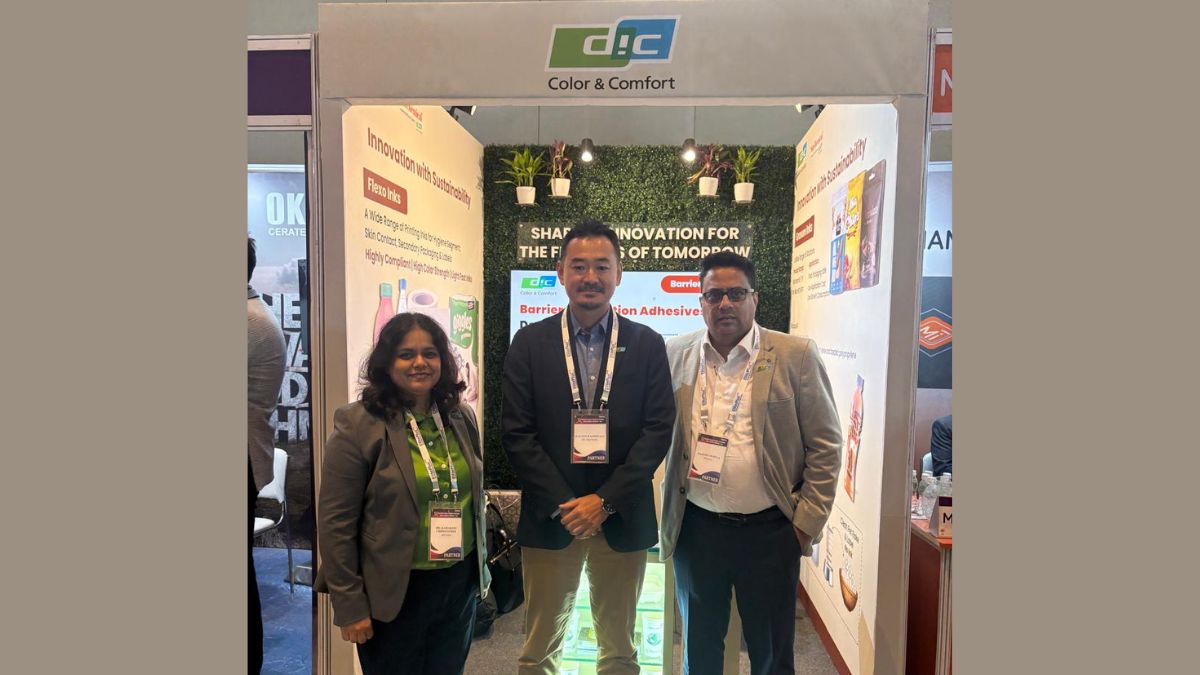
At the recently concluded ElitePlus Conference in Mumbai, Hayato Kashiwagi, regional business product director at DIC Asia Pacific, and Dr. Kamakshi Christopher, head of technology at DIC India, engaged in discussions with Labels Flexibles and More on the sidelines of the event. They shared valuable insights on the evolving landscape of sustainable packaging and highlighted DIC’s commitment to driving innovative solutions for the future. Their perspectives reflect a growing focus on sustainability in the packaging industry, emphasizing the importance of adapting to new challenges and consumer demands.
Driving Innovation Across Industries
Talking about the new development, Dr.Kamakshi said, “At DIC, we are excited to share our latest innovations across all segments of ink manufacturing, reinforcing our position as one of the largest producers in the world. With a comprehensive range of products tailored for both rigid and flexible packaging, we are addressing emerging challenges, particularly in the realm of recyclability. Our new de-inking platform is designed to tackle the complexities associated with labels and flexible packaging. Notably, we offer an extensive selection of PVC-free and NC-free inks, distinguished for their proven performance and global application. These sustainable options are set to lead the industry forward, ensuring that our products not only meet market demands but also contribute to a cleaner environment.”
“We are pleased to announce that our products meet all relevant compliance standards across leading markets such as the US, Europe, China, and Japan. We have developed a comprehensive range of solutions including both gravure and flexo inks, ensuring that our offerings align with the regulatory requirements of each of these regions. Our commitment to compliance guarantees that you can rely on our products in various applications worldwide.”
Navigating Towards Sustainability: Only Viable Option
Speaking about sustainability, Hayato said, “The Indian market presents an incredible opportunity for growth, and it’s always invigorating to engage with it. Key issues such as recyclability and circularity are at the forefront of our discussions. At DIC, we offer a wide range of solutions tailored for our customers and brand owners. However, a significant challenge we face is the uncertainty surrounding the future of the sustainability agenda. Whether it involves recycling, CO2 reduction, VOC reduction, biodegradability, or transitioning to paper, we must be adaptable to all potential pathways. It’s clear that sustainability as a concept is gaining traction, but brand owners remain undecided on the most effective direction to pursue.”
“The pace of moving towards sustainability remains slow in many regions, yet there is a growing belief that government regulations and laws could significantly accelerate this transition. A prime example can be seen in Europe, where strong regulations have led to rapid advancements in sustainability. Policies mandating a certain percentage of recycled materials in plastic products and outright bans on single-use plastics are crucial steps that have driven this shift. Similar regulatory frameworks in Asia, not just in India but across the continent, could play a pivotal role in fostering a more sustainable future. Such measures can help align industry practices with environmental goals, ultimately leading to a more sustainable society.”
Kamakshi added, “We are eager to collaborate with brand owners and converters to enhance sustainability in business practices. It’s important to understand that sustainability extends beyond environmental aspects; it also encompasses the financial viability of your business. To support this, we have localized our production processes, ensuring that all our products are readily available within your market. Alongside this, we are committed to delivering the highest quality technical service locally. Our offering is not solely about providing a product; we aim to partner with you by supplying excellent service and fostering brand recognition for your business. Together, we can create a sustainable future that benefits both our organizations.”
De-inking Processes: Transforming Waste into Recyclable Resources
Elaborating about the new de-inking technology, Hayato said, “De-inking technology has been a significant advancement primarily focused on surface printing. When recycled plastic enters the recycling process, any ink present on the printed materials or films impacts the color of the recycled product, leading to a lack of clarity in the final output. This results in what is known as downcycling, where the quality and utility of the material are diminished. The primary purpose of removing the ink is to facilitate a clear recycling process that allows the material to re-enter the original supply chain, thereby enabling upcycling possibilities rather than settling for downstream recycling options. Our developed technologies in this field are already commercially available, offering practical solutions for enhancing recycling efficiency and material quality.”
“The adoption of new technology, particularly in the printing and recycling industry, is currently very low, with less than 1% of the population utilizing it. The complexity of the technology, especially the specific washing processes involved, presents significant challenges. Even when using de-inkable inks, the recycling chain is not adequately equipped to handle these innovations. As a result, printed materials often end up in landfills or are incinerated, failing to complete a sustainable cycle. While the current infrastructure is not fully prepared for this advanced technology, there is optimism that customers and brand owners are taking proactive steps to adapt and prepare for its inevitable integration in the future. This forward-thinking approach is essential for ushering in a more sustainable era in printing and recycling.”